

Import a custom Keras script
This page describes the Machine Learning Manager, a service of the ForePaaS Legacy Platform that is not available on OVHcloud Data Platform. See the current documentation.
The Keras framework allows you to upload a Python .py file containing a Keras sequential model compatible with the Keras library.
When you select this framework, some packages are imported by default in the pipeline's environment:
- Keras
- Tensorflow
- the libraries that come out of the box with ForePaaS' SDK
Any other library used by your custom script has to be specified in the Python libraries field of the Dependencies panel (along with its version, if you wish to not use the latest one).
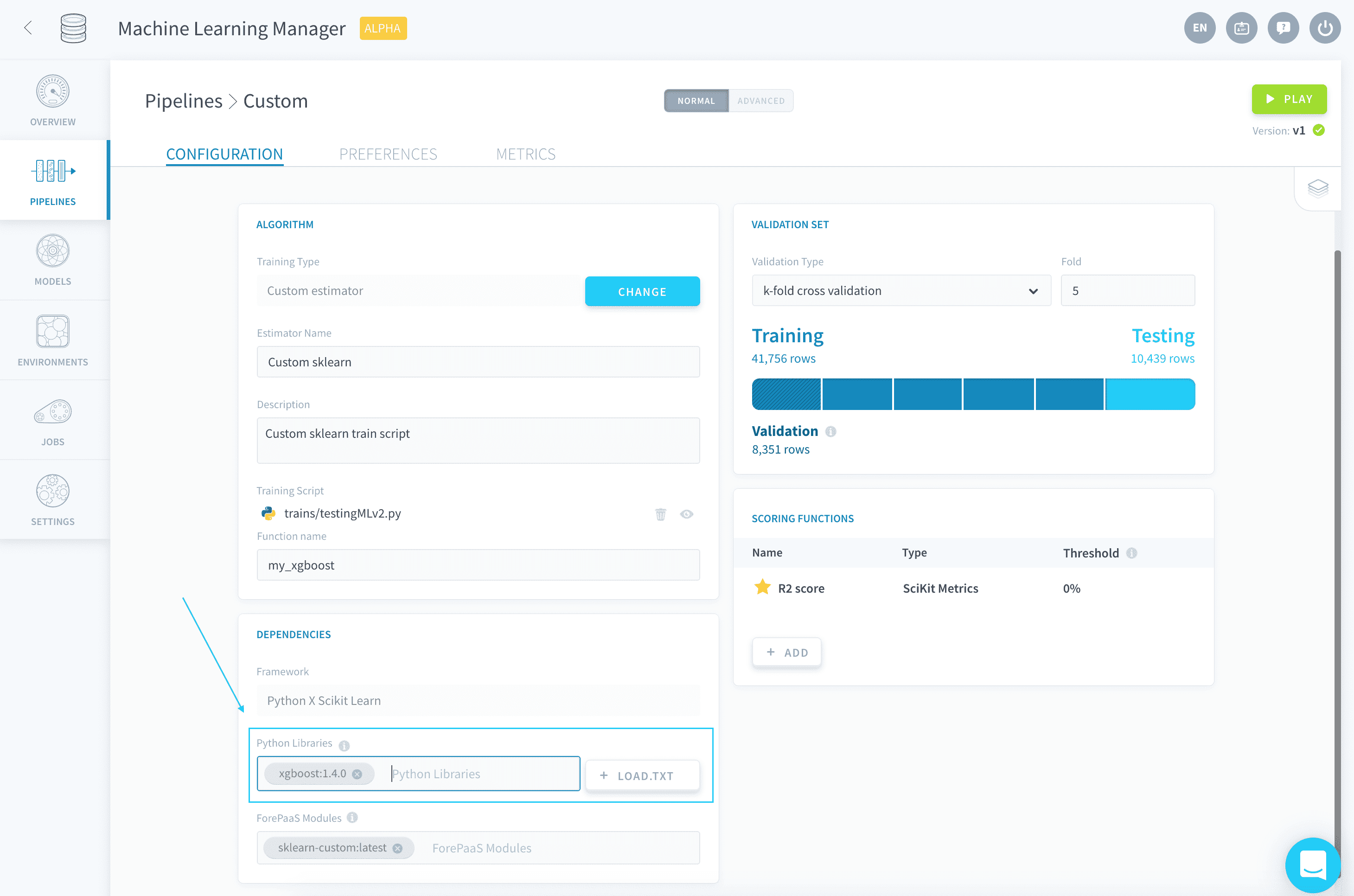
💡 You have the possibility to load a requirements.txt file in order to add all necessary libraries in one go.
By default, new pipelines will be using Python 3.9.9.
Upload a custom model
To upload a custom model, either drag your .py file into the Training Script box or click the box to open the file explorer.
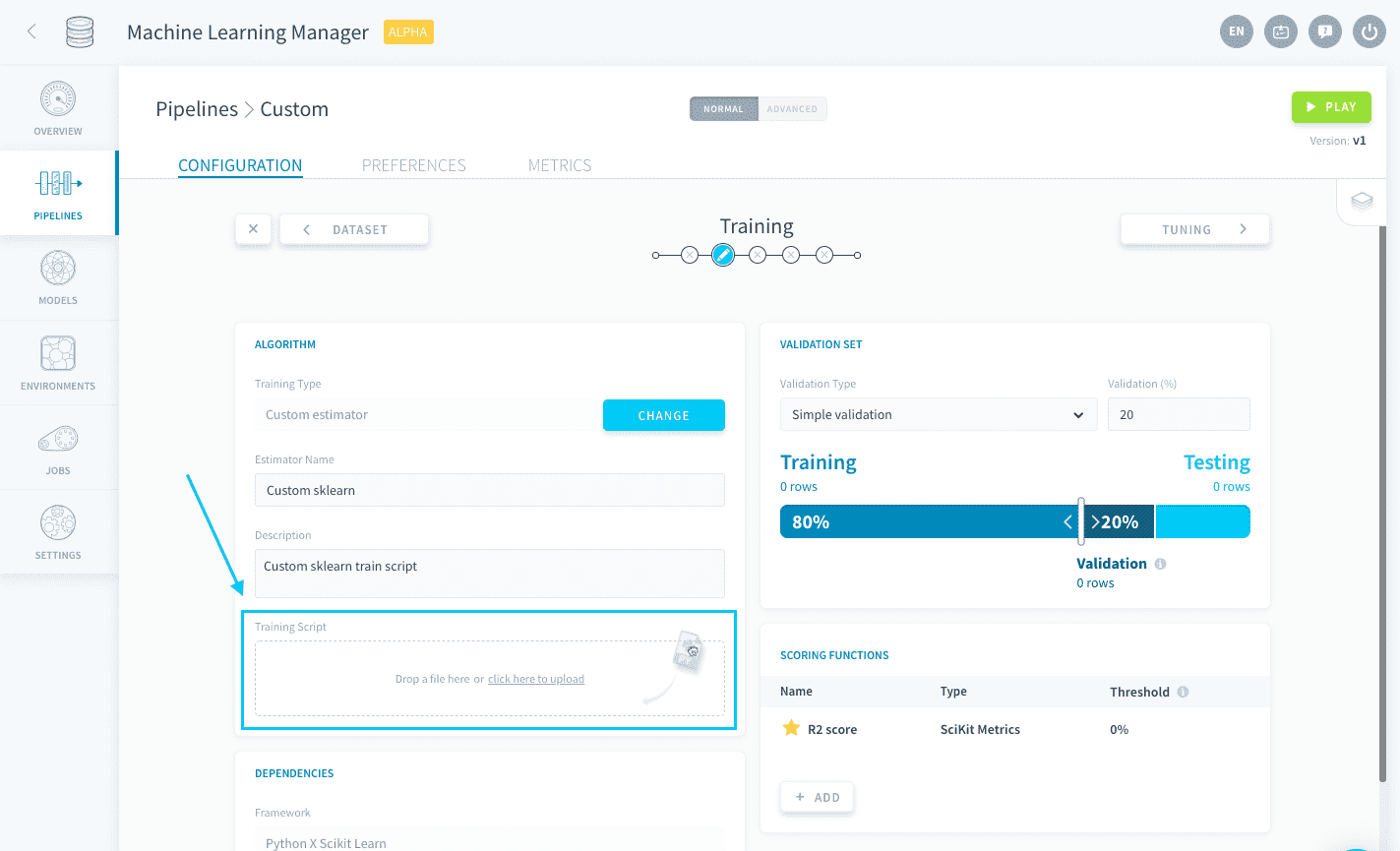
When a Training job is launched, this .py file is the file that will be executed. It must contain a function that has the following two requirements:
- It must have
eventas its first argument - It must return a fitted and compiled sequential model based on the training dataset
This function's name must be written down in the function name box.
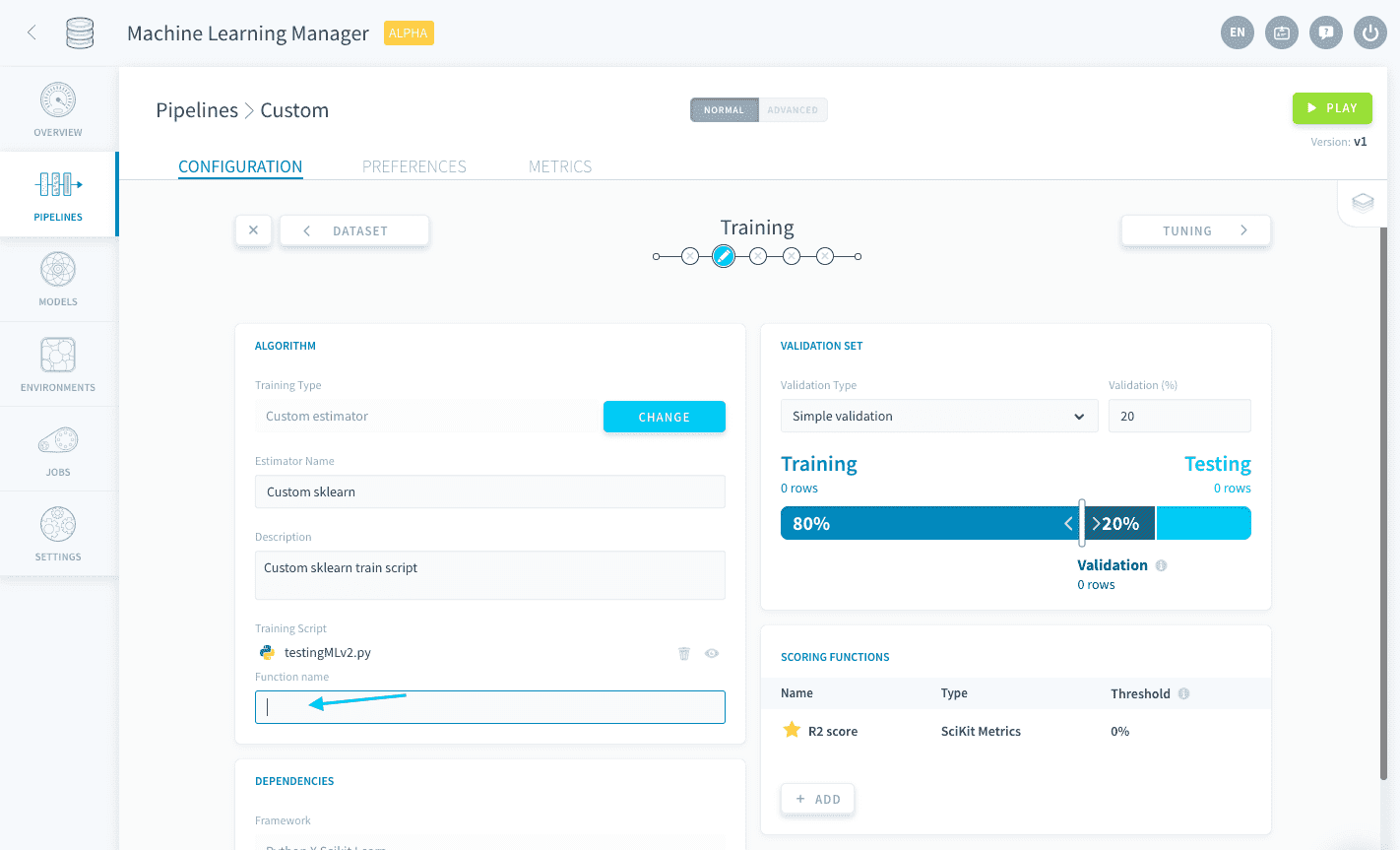
Below is a sample code of a basic custom Keras model using my_keras_model as the function name:
Due to the way the imports of libraries is handled by the platform, it is required to prefix imports from the keras library by tensorflow.
While the previous code will not be able to use any of the configurations made in the Training and Tuning steps, you have the possibility to connect to other parts of your pipeline configuration from your model thanks to the ForePaaS SDK. This allows you to use all the features provided by ForePaaS pipelines with your custom estimator.
The following configurations can be integrated:
- Use a validation configuration from the Training step
- Use a validation score function from the Training step
- Use hyper-parameters specified in the Tuning step
!> Since only the custom .py script is executed during Training jobs, failing to integrate the aforementioned configurations into the Python script will result in any respective interface-originated modification to be ignored by the pipeline.
Use Keras for unstructured data training
The Machine Learning Manager supports images for classification in training and predictions of Keras models.
Data preparation
To enable unstructured data training, the images must first be uploaded to the Data Store in a folder named after each class.
Learn how to carry out unstructured data preparation
Training
During training, the SDK methods get_train_dataset and get_test_dataset behave differently than with structured data. They both return two one-column DataFrames containing paths to the training images and associated labels (as .txt files). The column names for the images and labels are input and output respectively.
Labels are returned as integers based on the order they appear in the bucket starting from 0. For most cases, this will be alphabetical.
As such it is necessary to load and process the images and labels, as shown below in the sample code:
When an unstructured-data model is used for predictions later on, you are supposed to feed it the actual unstructured objects (images, etc.). The platform automatically 'numpyfies' them and applies standardization/normalization on them. As such, you must normalize the data entering the input layer of your neural network script too.
The rest of the Keras model can then be added with event as the only argument to the method:
💡 Multiple methods can be included in the custom .py, only the one specified in the
function namefield via the UI will be executed.
Neural network training can be accelerated by using GPUs in your ForePaaS pipeline. Check out the link below to learn more.